> ## Documentation Index
> Fetch the complete documentation index at: https://docs.privy.io/llms.txt
> Use this file to discover all available pages before exploring further.
# Cards
> Issue debit cards that spend stablecoins directly from a Privy account
Cards enable consumers and businesses to spend stablecoins directly from a Privy account at any merchant that accepts Visa. Your app issues virtual or physical debit cards backed by a Privy wallet, so users spend their onchain balance without manually offramping first.
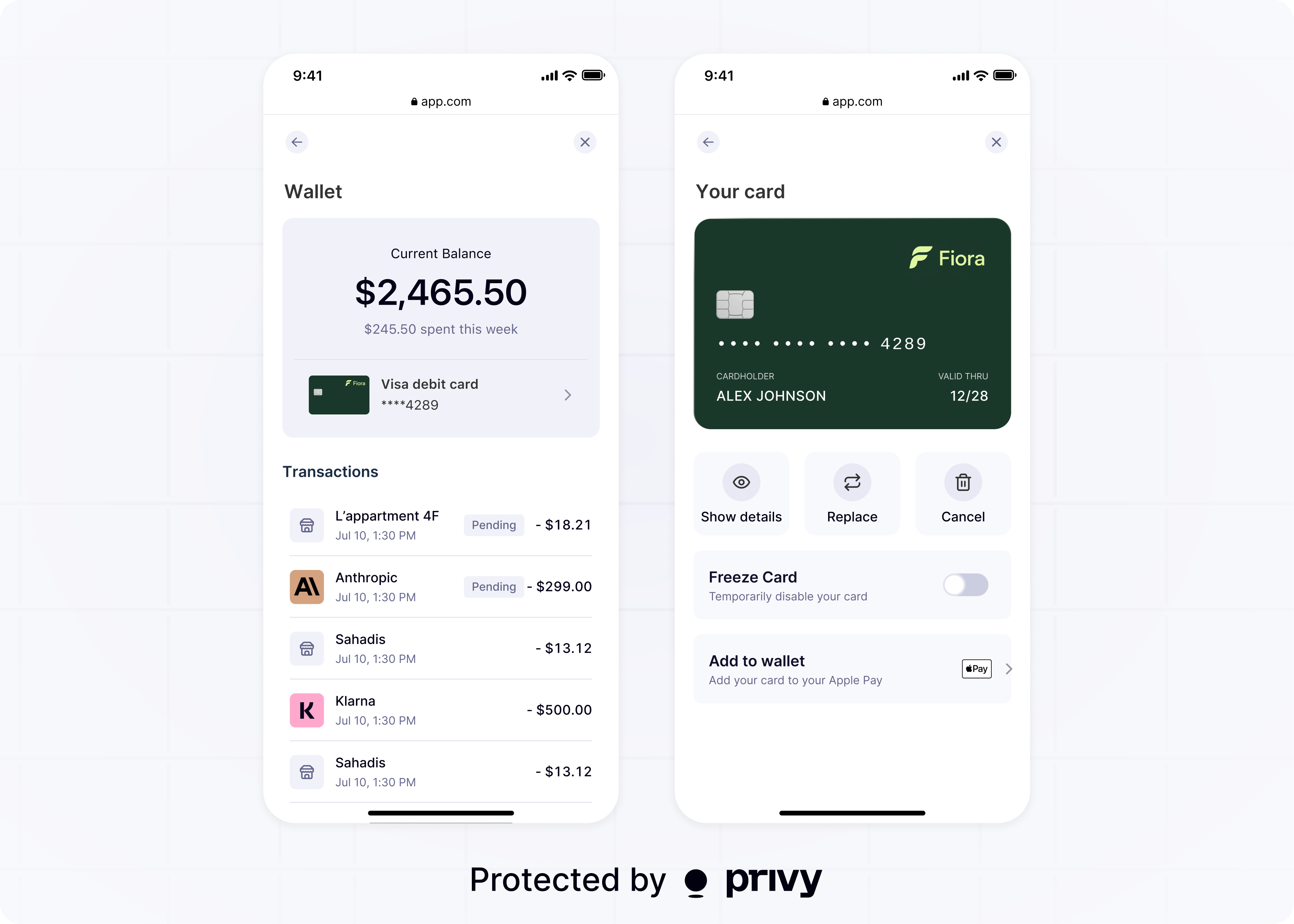 Card issuing is powered by [Bridge](https://bridge.xyz) and [Stripe Issuing](https://docs.stripe.com/issuing/bridge-stablecoin-cards). Bridge manages customer identity, KYC, onchain fund movement, and statements. Stripe Issuing creates the card and handles authorization, spend controls, and webhooks.
## How it works
Lead Bank issues the card, and Bridge is the program manager that moves funds onchain. Stripe provides Issuing, identity verification, and managed support, while Privy provides the embedded wallet, all in one integration.
Cards spend just-in-time from the account's stablecoin balance; funds are never preloaded onto the card. Each purchase pulls stablecoins from the account onchain at the moment of authorization. Wallet owners must submit an onchain approval so Bridge's smart contract can pull funds at authorization time.
[Prebuilt components](/financial-flows/cards/pre-built-components/overview) work for any
authenticated Privy user, including users authenticated with [custom JWT
authentication](/authentication/user-authentication/jwt-based-auth/overview).
## Spend from vault balances
Balances backing a card don't have to sit idle. Users can deposit their stablecoins in [Earn](/wallets/actions/earn/overview) vaults, where they accrue yield, and withdraw just-in-time to fund card spend. A single balance both grows and stays spendable, so users earn on their stablecoins right up until they use the card.
## Choose your integration
Privy supports two paths for launching a card program. Prebuilt components offer a managed path designed for faster time to market, while direct API integrations give your team more control over the customer experience, operations, and program economics. The right approach depends on how much of the program your team wants to own today and as you scale.
| | Prebuilt components | API integration |
| - | - | - |
| **Best for** | Teams prioritizing speed to market with a managed consumer card program | Teams that want greater control over their card program and customer experience |
| **How you build** | Prebuilt UI components in the Privy React SDK | Stripe Issuing and Bridge APIs |
| **Cardholder experience** | Pre-approved flows and UI provided by Privy | Custom UX and branding built by your app |
| **Customer relationship** | Card servicing and support managed by Stripe | Your team can own the end-customer relationship and support experience |
| **Compliance** | Powered by Stripe | Powered by Stripe or your in-house compliance team |
| **Economics** | Designed to make launching a program economical from day one | Variable economics designed to support programs as they scale |
| **Operations** | Core operational workflows managed for you | Greater ownership and flexibility across program operations |
| **As you grow** | Designed with a path to bring more functions in-house over time | Full control over the program from the outset |
**Not sure which path to choose?** Prebuilt components are designed for teams that want to get to
market quickly without building the operational stack themselves. If owning your customer
experience, support model, program economics, or other aspects of the card program is important
from day one, a direct API integration may be a better fit. Teams can also start with prebuilt
components and bring more of the experience in-house as they grow.
Embed bank-approved card UI with the React SDK.
Issue cards server-side with Stripe Issuing and Bridge.
## Get started
Prebuilt components are self-serve. Integrate them with the React SDK and test in sandbox, then contact [sales@privy.io](mailto:sales@privy.io) for production access.
Server-side API integrations begin with a guided Privy and Bridge onboarding. Reach out to [sales@privy.io](mailto:sales@privy.io) to get started.
This documentation is built and hosted on [Mintlify](https://mintlify.com), a developer documentation platform.
Card issuing is powered by [Bridge](https://bridge.xyz) and [Stripe Issuing](https://docs.stripe.com/issuing/bridge-stablecoin-cards). Bridge manages customer identity, KYC, onchain fund movement, and statements. Stripe Issuing creates the card and handles authorization, spend controls, and webhooks.
## How it works
Lead Bank issues the card, and Bridge is the program manager that moves funds onchain. Stripe provides Issuing, identity verification, and managed support, while Privy provides the embedded wallet, all in one integration.
Cards spend just-in-time from the account's stablecoin balance; funds are never preloaded onto the card. Each purchase pulls stablecoins from the account onchain at the moment of authorization. Wallet owners must submit an onchain approval so Bridge's smart contract can pull funds at authorization time.
[Prebuilt components](/financial-flows/cards/pre-built-components/overview) work for any
authenticated Privy user, including users authenticated with [custom JWT
authentication](/authentication/user-authentication/jwt-based-auth/overview).
## Spend from vault balances
Balances backing a card don't have to sit idle. Users can deposit their stablecoins in [Earn](/wallets/actions/earn/overview) vaults, where they accrue yield, and withdraw just-in-time to fund card spend. A single balance both grows and stays spendable, so users earn on their stablecoins right up until they use the card.
## Choose your integration
Privy supports two paths for launching a card program. Prebuilt components offer a managed path designed for faster time to market, while direct API integrations give your team more control over the customer experience, operations, and program economics. The right approach depends on how much of the program your team wants to own today and as you scale.
| | Prebuilt components | API integration |
| - | - | - |
| **Best for** | Teams prioritizing speed to market with a managed consumer card program | Teams that want greater control over their card program and customer experience |
| **How you build** | Prebuilt UI components in the Privy React SDK | Stripe Issuing and Bridge APIs |
| **Cardholder experience** | Pre-approved flows and UI provided by Privy | Custom UX and branding built by your app |
| **Customer relationship** | Card servicing and support managed by Stripe | Your team can own the end-customer relationship and support experience |
| **Compliance** | Powered by Stripe | Powered by Stripe or your in-house compliance team |
| **Economics** | Designed to make launching a program economical from day one | Variable economics designed to support programs as they scale |
| **Operations** | Core operational workflows managed for you | Greater ownership and flexibility across program operations |
| **As you grow** | Designed with a path to bring more functions in-house over time | Full control over the program from the outset |
**Not sure which path to choose?** Prebuilt components are designed for teams that want to get to
market quickly without building the operational stack themselves. If owning your customer
experience, support model, program economics, or other aspects of the card program is important
from day one, a direct API integration may be a better fit. Teams can also start with prebuilt
components and bring more of the experience in-house as they grow.
Embed bank-approved card UI with the React SDK.
Issue cards server-side with Stripe Issuing and Bridge.
## Get started
Prebuilt components are self-serve. Integrate them with the React SDK and test in sandbox, then contact [sales@privy.io](mailto:sales@privy.io) for production access.
Server-side API integrations begin with a guided Privy and Bridge onboarding. Reach out to [sales@privy.io](mailto:sales@privy.io) to get started.
This documentation is built and hosted on [Mintlify](https://mintlify.com), a developer documentation platform.